About Prabakaran Shankar
Research is my primary work. Building useful systems is how I extend it.
I am a materials researcher, scientific problem-solver, and systems builder based in South Korea.
Since December 2025, I have been working full-time as a researcher in the Advanced Nano-Robotic Systems Lab (ANRS Lab) at Chungnam National University. My primary professional responsibility is research: working with experiments, materials, data, uncertainty, and the decisions that connect them.
Outside my university responsibilities, I continue selected independent business projects. I also have a family life that I choose to keep largely private. These are not competing identities; together, they have taught me to value useful work, clear boundaries, and outcomes that improve real situations.
Last updated Jul 14, 2026
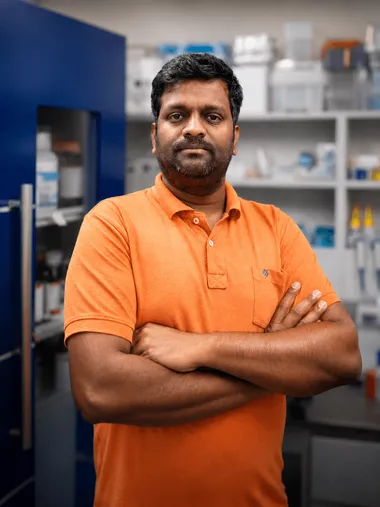
Researcher
I work full-time at the Advanced Nano-Robotic Systems Lab, Chungnam National University, where my attention is centred on laboratory research, experimental reasoning, and reliable scientific outcomes.
Builder and business operator
Outside my university responsibilities, I continue selected business and digital projects that solve practical problems in research communication, trusted documents, education pathways, and technology.
Husband and family member
Family gives context to ambition. It reminds me that useful work should create stability, dignity, and opportunity without consuming every part of life.
My independent ventures and opinions are separate from Chungnam National University and the ANRS Lab; they do not imply institutional affiliation, endorsement, or responsibility.
The path here
My way of working was shaped before I entered a laboratory.
Learning through responsibility
Work first taught me to observe people and systems.
At around sixteen or seventeen, I worked in a busy retail environment serving a large surrounding community. The work was ordinary, but the lessons stayed with me: pay attention, understand what people actually need, keep track of many moving parts, and remain dependable when the situation becomes busy.
Decisions under constraint
Not every important decision arrives with complete information.
My education did not unfold through a perfectly planned route. At one stage, I had already submitted an application and paid a fee to a college that clearly stated neither would be returned. Changing direction therefore carried an immediate cost, but continuing on the wrong path would have carried a larger one.
That experience taught me to distinguish between protecting a past decision and choosing the better next step. The same principle later became important in research: evidence sometimes requires us to revise a direction even after time and resources have already been invested.
Building before research
Business taught me that an idea matters only when it can operate.
In 2010, before my research career was established, I ran a small food-products business generating approximately USD 10,000 in annual revenue. I learned to work with customers, suppliers, quality, cash flow, deadlines, and uncertainty—all without the controlled conditions of a laboratory.
The business did not replace my academic direction. It gave me another way of understanding execution: a good idea must survive practical constraints and produce something useful for another person.
Becoming a researcher
Materials science gave structure to my curiosity.
I completed my Ph.D. in Materials Science in 2016 and continued research in India, Japan, and South Korea. My work has included nanomaterials, thin films, polymers and fibres, surface interactions, sensors, materials characterization, and the relationship between structure and function.
Across different laboratories and research cultures, I learned that difficult problems are rarely solved by one instrument or one clever idea. Progress comes from connecting observations, questioning assumptions, maintaining reliable records, and allowing the evidence to change the explanation.
The present chapter
Research remains the centre; building continues around it.
Today, my weekday professional focus is my full-time research role at Chungnam National University. Beyond those responsibilities, I continue a limited amount of independent business and digital work. I do this not to maintain a collection of unrelated titles, but because laboratory research and practical service repeatedly teach me the same lesson: understand the real problem, organize the evidence, build a workable path, and improve it through experience.
How I contribute
What I bring into a research team.
I do not enter a research discussion assuming that I already have the answer. I begin by understanding what the researcher intended, what was observed, what the available evidence supports, and where uncertainty remains.
I work alongside researchers rather than above them. The objective is not to take control of their work, but to bring an additional scientific perspective that helps make the next decision clearer.
Explore my research →- 01
Clarify the central research question and the decision that must follow
- 02
Connect preparation conditions, observations, characterization, and performance
- 03
Separate evidence-supported interpretations from attractive speculation
- 04
Identify missing controls, comparisons, or information
- 05
Organize fragmented results into a coherent scientific narrative
- 06
Develop responsible AI-assisted systems for literature, experiments, data, and writing
AI, research and execution
AI should extend an organized mind—not replace scientific responsibility.
AI can explore literature, compare possibilities, organize information, and reduce repetitive work. It can generate a map, but it does not independently understand every laboratory constraint or take responsibility for the final scientific decision.
I am interested in bridging AI-assisted planning with real laboratory execution: structured experiment records, connected data, transparent decisions, human interpretation, and defensible outcomes. The goal is not simply to produce more content or more ideas. It is to help the right work move forward with less avoidable friction.
Principles
The standards I try to carry across research, business, and life.
Evidence before certainty
I prefer a limited conclusion supported by evidence to a stronger claim that the results cannot defend.
Structure before speed
Moving quickly matters, but an organized question, record, and decision process prevents avoidable repetition later.
Technology in proportion
I use AI and digital systems where they reduce friction or reveal useful connections, while keeping judgment and accountability human.
Progress with responsibility
Research, documents, education, and digital systems all affect people. Trust and clear boundaries are part of the work, not additions to it.
Work with boundaries
Different responsibilities need clear separation.
My university research role, independent ventures, and family responsibilities each have their own place. I treat university time, institutional identity, confidential research, and laboratory resources as part of my academic responsibility—not as support for private work. Client and personal information must remain separate from my academic work as well.
Clear boundaries allow me to remain accountable in each role and to build trust without presenting one institution, project, or person as an endorsement of another.
Continue exploring