Thin films
CVD · RF/DC sputtering · Spray pyrolysis
Preparation and investigation of thin-film and nanostructured materials, particularly semiconductor and metal-oxide systems.
Materials · Interfaces · Sensing
My research spans functional materials, nanostructures, polymer systems, and sensors, with a particular interest in how preparation, composition, morphology, and interfaces determine material behavior.
Over the years, I have worked across different fabrication routes and material systems—from sputtered thin films and electrospun nanostructures to nanoparticles, hydrogels, and hybrid materials—and connected them to applications in sensing, electrocatalysis, and responsive materials.
What interests me most is not simply whether a material works, but why it behaves the way it does and what the experimental evidence allows us to conclude.
From preparation to application
My work does not sit within a single material or fabrication technique. It has developed across the chain connecting how a material is prepared, what structure it forms, how it behaves, and where that behavior can be useful.
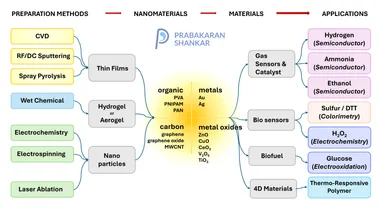
The map above summarizes the experimental space I have worked across. These areas are interconnected rather than independent specialties: a fabrication method changes structure; structure changes interfaces and properties; and those properties determine whether a material is useful for a particular sensing or functional application.
Fabrication and processing
My experimental experience includes both physical and solution-based preparation routes.
CVD · RF/DC sputtering · Spray pyrolysis
Preparation and investigation of thin-film and nanostructured materials, particularly semiconductor and metal-oxide systems.
Wet chemical synthesis · Electrochemistry
Preparation and modification of nanoparticles, hybrid systems, polymers, hydrogels, and functional interfaces.
Fabrication of polymeric and composite fibrous networks, including studies of morphology, crosslinking, structural reorganization, and functionalization.
Preparation and modification of nanomaterials through laser-mediated processes in liquids, including oxide and carbon-containing hybrid systems.
Material systems
My research experience spans several material families rather than a single platform.
ZnO · CuO · CeO₂ · V₂O₅ · TiO₂
Semiconductor and functional oxide systems investigated through thin films, nanostructures, nanoparticles, composites, and sensing interfaces.
Au · Ag
Metal nanoparticles and related hybrid systems, including their optical, surface, and sensing behavior.
Graphene · Graphene oxide · MWCNT
Carbon-based components used in hybrid materials, electrochemical systems, and functional interfaces.
PVA · PNIPAM · PAN
Polymeric systems investigated as fibers, hydrogels, responsive structures, and matrices for functional materials.
Structure → Function
Across these systems, I am interested in understanding how processing and structure influence measurable behavior.
This structure–property–function relationship is the common thread connecting much of my research.
Applications
Semiconductor and nanostructured material systems investigated for gases and vapors including hydrogen, ammonia, and ethanol.
Material interfaces developed for chemical and biological detection through colorimetric, optical, and electrochemical responses.
Functional materials and hybrid electrodes investigated for electrochemical reactions including glucose electro-oxidation.
Polymeric systems whose structure or properties respond to environmental conditions, including thermo-responsive materials.
From capability to evidence
The examples show how these capabilities have been combined in actual research—from electrochemical glucose oxidation and laser ablation in liquids to sputtered sensing structures and electrospun nanomaterials.
Rather than representing isolated projects, they show a recurring approach:
prepare the material → characterize the structure → identify the relevant behavior → connect the evidence to a functional outcome.
Browse all publications →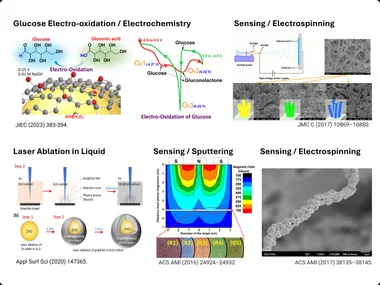
What I am exploring now
My current work continues to focus on materials science and chemistry with an emphasis on preparing and understanding functional materials for sensing and related applications.
I am particularly interested in systems where the experimental result raises a deeper question—unexpected structural changes, non-monotonic behavior, competing mechanisms, or differences between what was expected and what the material actually does.
One recent direction investigates treatment-induced reorganization of electrospun polymer nanofiber networks, examining how composition, crosslinking conditions, and network constraints influence the transition between disordered and directionally organized structures.
Explore the publication record
My publication record can be explored in three complementary ways.
Applications
Explore publications by the problem or application they address—from gas sensing and biosensing to biomedical materials and electrocatalysis.
Materials
Explore publications through their principal material systems, including zinc oxide, polymers, hydrogels, and composite materials.
Techniques and topics
Explore fabrication and deposition routes—spray pyrolysis, electrospinning, laser ablation, sputtering—associated with individual publications.
Collaboration
My experience across different materials, preparation methods, characterization techniques, and applications is useful when a research problem does not fit neatly within one technique or dataset.
Unexpected experimental results · Material characterization · Structure–property relationships · Sensing mechanisms · Experimental direction · Data interpretation · Manuscript development
The objective is not to force an explanation onto the data, but to determine what the evidence supports, what remains uncertain, and what experiment should come next.
Discuss a research challenge