
Nanostructured Cerium-Doped ZnO Thin Film: A Breath Sensor
Cerium-doped ZnO thin films sense acetone and ethanolamine, breath biomarkers for diabetes and liver disorders, with dopant concentration tuned separately for each target.
The largest body of work here: spray-pyrolysis, electrospun, and laser-ablated zinc oxide thin films and nanostructures, doped with nickel, manganese, cobalt, cerium, boron, fluorine, magnesium, and iron, mostly evaluated as room-temperature gas sensors.
Switching the spray-pyrolysis precursor solvent between water and ethanol tunes ZnO film thickness from 875 down to 150 nm, producing a distinctive water-hyacinth nanostructure along the way.
Spray-pyrolysis ZnO films made with different water-ethanol precursor solvents show the ethanol-only film selectively detects ethanolamine at room temperature, with a stable response over 30 days.
Adding chloride ions to an electrospinning precursor steers ZnO growth from nanospheres to pencil-like nanorods, and the nanorod morphology gives the strongest room-temperature ethanol response.
Fluorine doping shrinks ZnO crystallite size and increases micro-strain, and a 4 wt% fluorine-doped film gives the strongest, most selective room-temperature acetaldehyde response.
Cerium-doped ZnO thin films sense acetone and ethanolamine, breath biomarkers for diabetes and liver disorders, with dopant concentration tuned separately for each target.
Pure and iron-doped ZnO thin films are grown by sol-gel dip coating, a low-temperature alternative to spray pyrolysis, to study how iron doping shapes the resulting nanostructure.
Precursor volume alone steers spray-pyrolysis ZnO toward either better conductivity or better gas sensing, with a distinctive nanopetal morphology forming at 30 mL.
A thick ZnO film is evaluated for its room-temperature sensing performance across a range of volatile organic compounds.
Increasing iron-dopant concentration drives a clear shape transition in spray-deposited ZnO from rounded nanospheres to elongated nanorods, narrowing the optical band gap along the way.
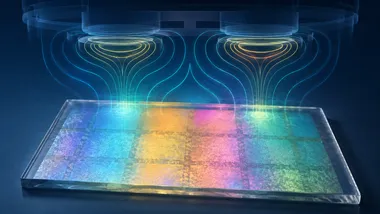
A sputtered zinc oxide film was expected to be uniform. Its unexpected colors revealed hidden differences in structure, composition, electrical behavior, and gas-sensing performance across a single glass slide.