A Practical System for Organizing Research Notes in Academia
How I keep literature, research ideas, experiments, meetings, references, observations, and unfinished questions connected without turning note-taking into another full-time job.
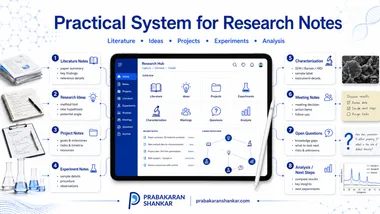
In brief
I do not try to keep every research note perfectly organized at the moment of creation. Instead, I focus on capturing what may matter — literature, ideas, observations, questions, discussions, images, and decisions — and later connect those pieces to the project where they become useful.
After trying paper notebooks, OneNote, Evernote, Google Notes, Word documents, and folder-based systems, I now use Obsidian as the main place where I connect research information. However, the tool is secondary. The more important part is understanding what deserves to be recorded and why it may matter later.
Research produces far more information than what eventually appears in a paper.
A published manuscript may contain a few figures and a few thousand words, but behind it there are often dozens of papers, failed experiments, lab observations, discussions, characterization files, alternative hypotheses, and ideas that were never pursued.
Keeping all of this organized has been a persistent challenge throughout my research career.
I have tried many systems.
Paper notebooks worked well inside the lab but were difficult to search later.
OneNote allowed mixed content in one place.
Evernote was convenient for quick capture.
Google Notes worked for short reminders.
Word documents were useful once notes became structured.
Folders worked well for storing files.

But once multiple research projects ran in parallel, I repeatedly faced the same problem:
I had the information, but I could not always recover the context in which it became important.
Today, I organize my notes around research projects rather than around tools.
Not all research notes are the same
One of the most important changes in my system was accepting that different types of research information serve different purposes.
A paper I read is not the same as an observation from an experiment.
A discussion with a supervisor is not the same as my own hypothesis.
A characterization result is not the same as my interpretation of it.
So instead of forcing everything into a single structure, I mentally separate research information into a few practical categories.
Literature notes
These are notes from papers, reviews, books, reports, or useful online sources.
For an important paper, I do not only want the citation.
I want to remember:
- what problem the authors addressed;
- what approach they used;
- the key result;
- their conclusion;
- limitations they acknowledged;
- uncertainties or assumptions;
- whether it supports or contradicts my own observations;
- what idea it suggests for my work.
I may also store key figures or diagrams when they help me understand the work later.
The goal is not to reproduce the abstract.
The goal is to preserve why I cared about the paper in the first place.
Literature management itself is a broader topic and deserves separate discussion.
Research ideas
Ideas appear unpredictably.
While reading a paper.
During an experiment.
While analyzing SEM images.
During discussions.
Or after a failed experiment.
This is something every researcher experiences. If you have a method that works well for capturing ideas, I would be glad to learn from it.
I try to capture ideas even when they are incomplete.
An idea note may start as:
Try lower concentration.
or:
Could thickness be controlling this behavior?
or:
Compare this with crosslinking-induced shrinkage.
Most ideas will never become projects.
But recording them removes the need to keep them in working memory. This is a habit that improves clarity across many areas of research.
Questions are often more valuable than answers
I increasingly treat questions as first-class research notes.
For example:
- Why does this morphology appear only in thicker samples?
- Has this mechanism been reported before?
- Is this a chemical effect or a processing effect?
- What characterization can distinguish these possibilities?
- What control experiment is missing?
Research often progresses when a question becomes precise enough to test.
This is why I avoid notes that contain only summaries.
A summary tells me what I already know.
A question tells me where the research can go next.
Project notes
Every active project needs a central place that answers:
What is happening in this project right now?
This becomes the project index or project notebook.
It connects the major components:
- Problem statement
- Literature
- Experimental plan
- Samples
- Experiments
- Characterization
- Analysis
- Open questions
- Next steps
- Manuscript
The project note does not need to contain everything.
Its purpose is to guide me to everything else.
This is why I prefer linked notes over deeply nested folder structures.
Experiment notes
Experimental notes require a different level of detail, so I treat them separately.
During experiments, I usually keep a physical notebook nearby to record:
- temperature;
- humidity;
- material details;
- solution appearance;
- sample labels;
- processing changes;
- unexpected observations;
- timing;
- deviations from the plan.
I also take photographs of setups, samples, and visible changes when relevant.
I do not try to make these notes polished during the experiment.
The goal is to avoid losing information.
Organization happens later, after the experiment.
I describe the fuller capture-link-review workflow, from a raw observation to a note I can trust months later, in From Scattered Notes to a Trusted Knowledge Base.
Characterization notes
Characterization data can easily lose meaning without context.
A file named:
sample3_sem_final2.tif
may be understandable today but meaningless months later.
So I try to preserve the relationship between:
sample → preparation → treatment → characterization → observation
I also record:
- instrument used;
- sample label;
- measurement conditions;
- handling details;
- anomalies during measurement;
- immediate observations.
These details often become critical when comparing similar samples that behave differently.
Meeting and discussion notes
I do not aim to record full transcripts of meetings.
What matters more is:
- What was decided?
- What question was raised?
- What should be checked next?
- What suggestion was important?
- What action is required?
A single comment from a supervisor can be more valuable than pages of general notes.
For example:
Check whether thickness, not chemistry, is responsible.
Capturing that insight is more important than recording every sentence spoken.
Images as part of reasoning
Research is highly visual.
SEM images, spectra, graphs, photographs, sketches, and screenshots often carry meaning that text alone cannot.
So I keep relevant visuals close to the notes where they are discussed.
- Literature notes may include key figures.
- Experiment notes may include sample photos.
- Characterization notes may include raw outputs.
- Analysis notes may include plots that triggered insights.
Images are not decoration.
They are part of the reasoning process.
Separating observation from interpretation
This distinction is essential.
For example:
Fibers became more aligned after treatment.
This is an observation.
Possibly due to treatment-induced internal stress and increased mobility before fixation.
This is an interpretation.
I prefer to structure notes as:
Observation What was directly seen or measured.
Interpretation What might explain it.
Evidence What supports the interpretation.
Question What remains uncertain.
Next step What experiment or analysis could clarify it.
This structure makes it easier to revise interpretations without losing experimental integrity.
I do not organize everything immediately
One common failure in note systems is requiring too many decisions at the moment of capture.
Which folder?
Which tag?
Which project?
Which structure?
If note-taking becomes too slow, it interrupts research itself.
So I prioritize capture first.
Structure comes later, during review or reflection.
This separation has significantly improved my workflow.
Where Obsidian fits
After trying multiple tools, I now use Obsidian for most of this system.
The key reason is not a specific feature, but the ability to connect Markdown notes into a network of ideas.
A literature note can link to an experiment.
An experiment can link to a sample.
A sample can link to characterization.
Characterization can link to analysis.
Analysis can link to a manuscript.
I describe the setup and workflow in Obsidian for Research: A Practical Project Workflow.
However, the tool itself is not essential.
The underlying principles matter more than the software.
Search is useful, but context is better
Search tools are powerful, but they only retrieve fragments.
They do not always retrieve meaning.
For example, finding:
Increase EG to 20%
is useful.
But a connected note can also show:
- why the change was considered;
- which experiment led to it;
- what problem it aimed to solve;
- what happened afterward.
That context is what makes research notes truly valuable.
Notes improve collaboration
A well-structured research record is useful beyond personal use.
When discussing with supervisors, collaborators, or students, I can provide:
- experimental conditions;
- sample history;
- before/after images;
- characterization data;
- related literature;
- unresolved questions.
This makes discussions more focused and productive.
Notes become more powerful with AI
AI tools can help summarize, search, compare, and structure information.
But they become significantly more useful when given proper context.
There is a big difference between asking:
Why did this experiment fail?
and providing:
Here are the preparation details, environmental conditions, material source, images, previous successful runs, and characterization data. Identify the most likely variable that changed.
The second approach works because the research record is structured.
In this sense, notes are no longer just memory aids.
They become structured context for better reasoning.
I will discuss this further in Organizing Research Notes in the AI Era.
What I am ultimately trying to preserve
I do not aim to store everything I encounter.
I aim to preserve what allows me to reconstruct the research process.
For any important result, I should be able to recover:
- What did I know?
- What did I observe?
- What did I think it meant?
- What evidence supported it?
- What did I decide to do next?
If my notes allow me to reconstruct that chain months later, the system is working.
This is how I now think about research notes.
Not as a perfect archive.
Not as a productivity system.
But as a record of how understanding gradually emerges in research.