From Scattered Notes to a Trusted Knowledge Base
A capture, link, and review system that turns raw research notes into a linked knowledge base you can trace every claim back to.
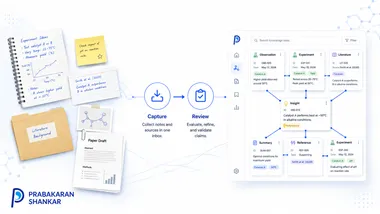
In brief
I keep research notes in three states: capture, linked, and reviewed. New information always lands in one place first. A short, honest review moves the useful parts into permanent, linked notes and lets the rest expire. The system’s only job is to make sure a claim I make later can be traced back to the raw observation that produced it.
For a long time my note-taking problem was not a lack of notes — it was too many of them, in too many places, with no way to tell which ones still mattered. A good idea from a Tuesday afternoon would sit in a notebook, a half-finished paragraph in a document, or a screenshot in a folder, and by the time I needed it again I could not reconstruct why I had written it down.
What changed things was separating two questions I had been treating as one: where do I put this right now and where does this belong permanently. Answering both at the moment of capture is what made note-taking feel expensive. Splitting them apart is the entire system below.
Capture
Capture has one rule: write it down where you are, not where it should eventually live.
Everything — a citation worth chasing, a stray idea, an instrument reading, a question from a meeting — goes into a single daily log first. I do not decide its category, its links, or its importance at this point. Deciding those things later, in bulk, is faster and more accurate than deciding them one at a time under interruption.
What I actually capture, without editing it:
- the source: a citation, a URL, or who said it in a meeting;
- the observation itself, in as few words as it takes to be unambiguous later;
- the date and, for lab work, the sample or run it belongs to;
- an open question, if the note raises one.
Capture now, structure later
A note written in ten seconds during an experiment is more accurate than a polished paragraph written from memory that evening. Resist the urge to file, tag, or link at capture time — that friction is what makes people stop capturing.
The note types I actually keep
Once something survives a review, it moves into one of a small number of permanent note types. I deliberately keep this list short; every additional type is another decision I have to make correctly every single time I write something down.
- Literature notes — one per source, answering what the authors actually demonstrated and how it affects my work, not a copy of the abstract.
- Observation notes — a direct record of what I measured or saw, kept separate from what I think it means.
- Research notes — hypotheses, mechanisms, and open questions that span more than one observation.
- Meeting notes — decisions and owners, not transcripts.
- Project index notes — one per active project, linking out to everything above instead of duplicating it.
Everything else — drafts, checklists, half-formed ideas — stays in the daily log until it either graduates into one of these five or expires unreviewed. Expiring is not a failure; most captured notes were only ever useful for a day.
Linking over folders
A folder can only answer one question: where is this file. It cannot tell you why this file matters, or which other notes depend on it. I use folders for the five note types above and nothing more granular than that — the organization that actually matters happens through links.
Concretely, an observation note links to the project it belongs to, the method it followed, and any literature note that motivated it. A research note links back to every observation that supports it. This means the connective structure is stored once, next to the information it connects, instead of being reconstructed from memory every time I need it.
I also keep a small, fixed set of properties on every note — project, status, created — and resist adding more. A property that is not consistently filled in is worse than no property at all, because it makes the notes that do have it look unreliable too.
Review: where notes earn their place
This is the step that makes the rest of the system work, and it is the one most people skip.
End of day — a five-minute pass over the daily log. Anything worth keeping gets moved into a proper note and linked. Anything that is not gets left where it is; I do not delete it, but I stop treating it as active.
End of week — a slower pass, usually 20 to 30 minutes. I read through the week’s new notes looking for one thing specifically: does a pattern across three or four separate observations now support a claim that no single one of them did? If yes, that claim becomes its own research note, linked back to every observation behind it. If a research note has not been touched or linked to in several weeks, I ask whether it is still active or should be marked closed.
The test I use
Can I start from a claim I am about to make and walk backward to the specific observation, sample, and date that support it, without relying on memory? If the answer is yes, the review is doing its job. If the answer is no, the gap tells me exactly which habit slipped that week.
Mistakes that taught me this system
- Treating the daily log as permanent storage. Notes accumulated there indefinitely because “reviewing” never had a defined end point. Giving review a fixed weekly slot fixed this more than any tool change did.
- Tagging everything I wasn’t sure how to classify. The tag list grew faster than it was useful, and searching it became its own research problem. I now default to no tag and only add one that I expect to use again within a month.
- Writing interpretation into the observation. Early notes mixed what I saw with what I thought it meant, which made it impossible to revisit an interpretation without also questioning the underlying data. Keeping them in separate lines, even in the same note, solved this.
- Letting review slip for a month. The backlog stopped being reviewable in any reasonable amount of time, and I ended up archiving weeks of notes unread rather than catching up. A shorter, more frequent review recovers from a skipped week; a long one rarely does.
The tool is not the system
None of this depends on a specific app. I currently do it in Obsidian, because a vault is just a folder of plain Markdown files with links between them, which matches the capture-link-review model directly rather than fighting it. The concrete setup — vault structure, templates, and the note types above as actual files — is covered in Obsidian for Research: A Practical Project Workflow.
But the system predates the tool, and it would survive a tool change. What would not survive is skipping the review — that is the one step with no substitute.